The Speculative Present
The following is a talk I gave in the spring of 2021, during COVID and when I was a (miserable) grad student working on a PhD in history. My studies focused on Black print culture, and understanding the ways in which fiction was used as a platform for Black social- and cultural criticism. While I left the program the following year, this little project was the culmination of years of trying to answer the question of how one might study a people that was brutally suppressed, without smuggling into one's research the biases and manipulations of their hegemons.
Looking back on this project, I was surprised how much I recalled — my memory tends to vanish under stress, and fuck me if 2021 wasn't a stressful time — and how salient I think this argument still is. For those who have no background in the subject, much of Black American history has proven incredibly difficult to study. Even those texts that have been celebrated as "good" Black history (that is to say, Black American history that does not reify the white supremacists structures of the subject matter) such as Steven Hahn's A Nation Under Our Feet largely rely on an extreme minority of Black records. Hahn's work pulls almost entirely from the proper nouns of Black history. Names that researchers in the field have heard thousands of times. It makes little effort to account for the innate class/cultural biases of taking those extreme few who made a name for themselves within the extremities of the antebellum south.
Work done by Black feminists such as Marisa Fuentes's Dispossessed Lives or Saidiya Hartman's Wayward Lives, Beautiful Experiments instead practice what Hartman described as a "reading against the archive" and "critical fabulation" to take the extremely limited records of mostly unnamed Black women and tease out little threads of Black womenhood that the white supremacist archives overlooked or accidentally allowed. This body of work is truly wonderful and I'd recommend both of these books to anyone interested in the subject matter. They are empathetic and of a literary quality that few historical projects manage, and as such are compelling not only as historical arguments but also as literary works in their own right.
I'm not sure how much work from this period I'll be sharing but this was the obvious choice. I've been playing Metaphor ReFantazio and its metanarrative — which asks the question: "can a fantasy story really impact the real world?" — has reminded me of this project. I'll have much to say when I finish the game.
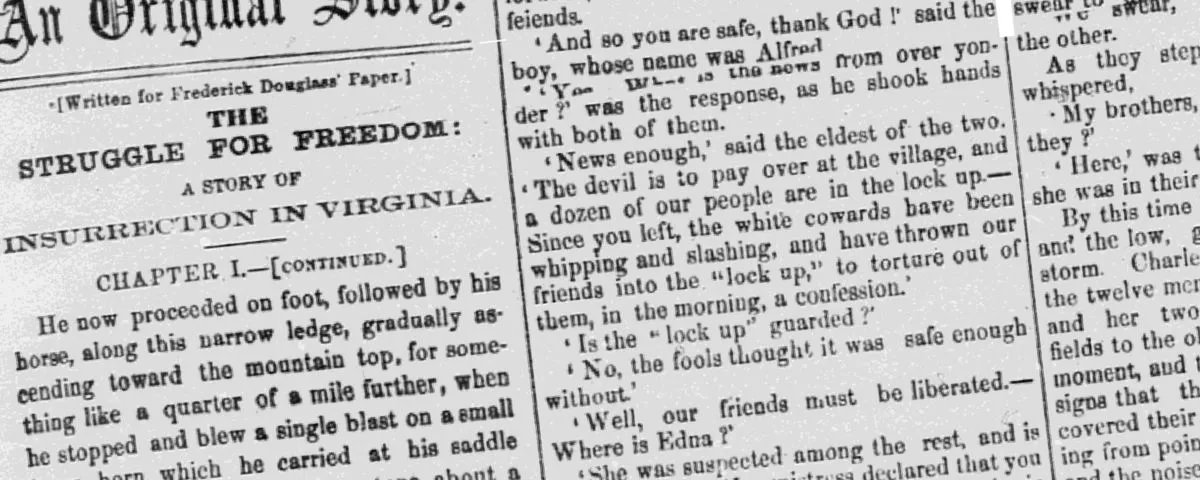
The focus of this talk is a chapter-and-a-half from an unattributed serialized novel, published in Frederick Douglass’s Weekly on February 17th, 1860. The novel, titled The Struggle for Freedom: A Story of Insurrection in Virginia (which I may refer to by the shorthand “Struggle”), follows the protagonist Captain Charles as he is freed from enslavement, joins a band of formerly enslaved Black revolutionaries, and aids in the freeing of other enslaved people. This brief talk will address the contents of the passage, its relationship to the genealogy of Black speculative fiction, and argue for the vitality of documents like these for understanding Black political and intellectual life without falling into the pitfalls of colonial archives. In order to do so, I will first establish was is Black Speculative Fiction, then take you through this selection of Struggle and its similarities to other Black speculative texts, and then briefly discuss its historical implications.
Unfortunately, to date, the confines of digital archives have left me with only one serial printing of Struggle, which has the end of Chapter 1 and all of Chapter 2. While I’m optimistic copies of the issues before and after have survived, Frederick Douglass’s Weekly was gradually replaced by the Frederick Douglass’s Monthly from 1859 until around Summer 1860, making distribution more tenuous during this period.
Black Speculative Fiction
You may be more familiar with the term ‘Afrofuturism,’ which is a literary genre closely associated with authors like Octavia Butler or works such as the recent Black Panther film. “Afrofuturism,” in common parlance, usually refers to science fiction works which meditate on the relationship between possible futures for Black or diasporic peoples in light of the actual, or an alternative, past. Frequently, this manifests in conceptions of Black-made technology which changes the world, Black nationhood and utopias, or successful Black revolution.
However, while Afrofuturism is the more common term, and is often used as a synonym for Black speculative fiction among scholars, I opt instead to use the term “Black Speculative Fiction,” as it distances the work I’m focused on from the genre of science fiction. Black speculative fiction includes not only traditionally Afrofuturist texts, but also popular 19th and early 20th century fiction genres such as passing narratives, travel narratives, counterfactual histories, and others, which were used by Black authors to speculate on the cultural and political debates of their time period.
I choose not to use the term “Afrofuturist” because, frequently, these novels are based in the present, and consider or speculate on current issues, without traditional sci-fi elements such as futuristic technology. By using “Black speculative fiction” instead of “Afrofuturist” I expand my focus to all those works of fiction which address the possible formation or commentary on Black nationhood, by Black authors, regardless of their particular genre conventions.
Regardless of whether a text is science fiction, these stories can be absurd or fantastical in nature, sometimes contrasting fantastical or surrealist events within a narrative which otherwise takes conventions from realist literature. They frequently rely on popular tropes in both Black and White popular fiction of the time, such as passing characters (particularly tragic women characters whose race being unveiled pushes the plot forward), or ancient African civilizations along with ancient African royalty. Despite these elements, they all place themselves firmly in the ‘real’ world and concern themselves with fairly immediate political or cultural issues such as colorism, miscegeny, American imperialism, etc.
Black Speculative Genealogy
Black speculative fiction has had a growing body of both primary and secondary literature. Through the work of scholars in English and Literature departments, Black speculative fiction has seen something of a renaissance as new serialized novels are discovered, collected, and redistributed to a new audience. As many of these novels, dating from about 1860 to 1940, were only realized in a serialized form, or only in print for a brief period, pieces such as Struggle—where only one fragment is readily accessible—are common, and even some of those texts which are vital to the genealogy of the genre are still missing chapters even years after their rediscovery by scholars.
While many of the works most closely associated with the term “Afrofuturist” were published after World War II and the Civil Rights Movement in the 1960s, literary scholars have traced the greater trend of Black Speculative fiction back to Martin Delany, and his Seminole Blake; or the Huts of America, published as a serialized novel in two parts first in 1859 then from 1861 to 1862, and tells a tale of international Black revolution, led by the enslaved, and written in response to Uncle Tom’s Cabin.
The genre would then balloon proportionally with the rise of Black print culture, around the turn of the century, in what has been referred to as the “post-bellum/pre-Harlem” period from reconstruction to World War I. Key authors include James Corrothers, Sutton Griggs, George Schuyler, Pauline Hopkins and W.E.B. DuBois.
Notably, as Struggle was published without attribution, one might suppose that Martin Delaney spent 1860, when he was not occupied with Blake writing Struggle. Indeed, Delany was associated with Frederick Douglass, as well, having worked with Douglass on other papers such as the North Star previously. However, in May 1859 Delany had relocated to Liberia, then Nigeria, and then again to England in April 1860. Additionally, while I haven’t familiarized myself with his entire bibliography, Delany is usually considered an early Black nationalist with an international proto-Pan-African approach, while Struggle is much more narrowly focused. Further, Delany and Douglass were rather estranged due to Delany’s radical politics, and it is only after his plans in Africa had issues, that Delany moved to England and continued Blake. These factors make it possible but unlikely that Struggle was written by Delany.
The Struggle for Freedom: A Synopsis
Chapter 1:
As I noted, Chapter one is only partially available, but what is present alludes to Charles’ own escape from enslavement, something which is relevant again in the events of Chapter two, as well as Charles’ arrival at the mountain hide away that serves as the base of operations for the band. This includes a brief description of the fantastical cavernous base that Charles and his band occupy.
This cavern is hidden by a large stone door, which closes flush with the mountain side as though it didn’t exist at all. Approaching the hidden door, Charles, with his horse and a supply cart, gives the password “Arrow Head,” which prompts the door guard to open up. This is the most fantastical element of the selection, and one which places Struggle in dialogue with both other Speculative authors, and alludes to a very real contention both among contemporary abolitionists and modern scholars: that of Black fugitive technologies.
The door’s mechanism is described thusly: “The ingenuity and mechanical skill displayed in this contrivance, as well as in the gate below, is all explained by the fact, that the man who had just led Charles into the cave, tho’ a fugitive slave, was a stone mason, and had the assistance of Charles and a half dozen other fugitives, in constructing these defenses to the great natural fortress”
This explicit allusion to the skill of a fugitive slave, completing a task no one had done before, something which would be difficult today let alone for the best trained white stonemasons of the time, demonstrates the understanding the author had that enslaved Black folks were not ‘broken’ by the dehumanization of enslavement. Rather, the enslaved were a supremely skilled group of people, not only in their ability to organize a secret revolutionary force, but also in artisanship and technology. The work of scholars such as Stephanie Camp and Saidiya Hartman, among others, have shown how sophisticated enslaved (and Black generally) survival strategy can be, and Struggle demonstrates that contemporaries agreed.
Notably, this concept of a hidden door produced by Black technology is repeated in George Schuyler’s Revolt in Ethiopia, an Afrofuturist text published in the 1930s, also as a serialized novel, which depicts a similarly hidden stone door being used to hide an ancient Ethiopian spiritual center from Italian fascists. This trope, which relates Blackness and Black technologies to indigeneity (doubly so alongside the allusion to indigenous Americans in the password “arrow head”) and diaspora, is used in Struggle as in Schuyler to emphasize the emphatic resistance of Black people to white hegemony, not only through political action but through technologies developed away from white eyes.
Chapter 2:
Chapter 2 is told in two parts. The first follows Charles’ jail break of his lover, Edna, as well as others accused (and incarcerated as punishment) of helping Charles to escape. With the help of Edna’s brothers Alfred and Cyrus, Charles raids the plantation jail, breaks off the lock, and escapes back to the mountain hideaway under the blessing of conspicuously opportune rainfall. The latter half describes one of the newly arrived fugitive’s inductions into Charles’ band, by way of a “telling of experience” proctored by an elder with a copy of the Old Testament. I’ll be focusing on the second section.
This latter portion again describes a particularly astute understanding of the conditions of the enslaved. The “telling of experience” offered by Hugh, the inductee, describes the experience of he and his wife, Lucy, on the plantation they’ve since escaped from.
Lucy, who is “part white” — placing her in conversation with passing narratives of the time (which as you recall frequently feature tragic mixed race women) — was aggressively harassed by the Plantation owner’s son. Hugh, upon learning of the son’s harassment, arms Lucy with a knife, and is subsequently separated and imprisoned as retaliation for raising concerns about the son with the owner. Lucy secretly unlocks Hugh’s cell, and after waiting for the coast to be clear, Hugh hurries back to he and Lucy’s home, where he arrives just in time to see Lucy stab the son as he tries to assault her, at which point Hugh kills the overseer that the son had brought along to aid him.
Hugh and Lucy’s narrative articulates unambiguously the intimate knowledge of free Black folks with the gendered and violent nature of life on plantations. While recent Black feminist scholarship has greatly illuminated our understanding of the culture of the plantation, Black women’s experience with it, and the ways in which violence manifests upon it, Struggle articulates many of the same ideas in a distributed paper as an aside to a larger narrative—suggesting a familiarity both of the author and the audience.
Struggle in the Paper
Struggle was published alongside a series of reflections, commentaries, and sermons in reaction to the execution and continued trials of John Brown and his cohorts, who led the assault on Harpers Ferry, Virginia in October of 1859. John Brown, a white radical abolitionist, was found guilty of treason unanimously and executed by hanging in December of 1859, an event which has been described as the beginning what would culminate in the Civil War. John Brown, as described in this issue of Frederick Douglass’s Paper, had become something of a martyr among abolitionists and in the Black community. His execution, and the trials especially of those who both aided his defense in court and in the raid itself, became the genesis of prescient speculation among Black authors and editors that greater conflict was imminent.
Viewed in this lens, and without its subsequent chapters, The Struggle for Freedom: A Story of Insurrection in Virginia (emphasis on the subtitle now) takes on the role of yet another meditation on the Harpers Ferry incident. One in which the protagonist is a Black revolutionary guerrilla, rather than a white abolitionist.
This sort of internal commentary is typical of the genre. Sutton Griggs’ Imperium in Imperio, a favorite of Afrofuturist scholars, describes a secret government within the American south headed by Black characters based on Booker T. Washington and W.E.B. DuBois, two figures which dominated the discourse on post-reconstruction Black political strategy. James Corrothers’ A Man They Didn’t Know, similarly, examines the significance of Black soldiers in the Pacific theater through a counterfactual history in which Black soldiers, pitched to the President of the United States by a small cabal of Black intelligentsia, prevent an invasion of America by a pan-Asian force, a clear response to new American imperialism at the turn of the century.
This trend in Black speculative fiction to discuss current events and their implications for Black life is the chief significance of this genre and these texts in the discipline of history. Where nonfiction sources can be illuminating for understanding the thoughts and arguments of Black intellectuals, fiction gives a platform to express both the less intelligible nuances of anti-racism in such an extreme context as 19th Century America, and to work out frustrations of the author or audience that would have difficulty being printed due to risk of white scrutiny or editorial interference. Further, while white sympathetic literature like Slave Narratives or novels like Uncle Tom’s Cabin are ostensibly written for the betterment of Black peoples, their direction at white audiences undermines their archival value if one is studying Black politics.
Decolonizing the archive
Black fiction like this is also a solution to an archival problem. While the archive of enslavement, in particular, and of Black life generally, is rife with conspicuous omissions, silences, and distortions by way of the white supremacist state which sponsored their production, Black print carries the possibility of smuggling the contentious into the archive. As scholars of Latin America and South Asian, among other, cites of coloniality have realized previously, literature produced by the oppressed is frequently a means to express those ideas which invite personal harm, censorship, or curation by those who may be implicated in its publication. By publishing fiction that takes onboard a hint of absurdity, via tropiness or fantasy, Black authors created room for themselves to discuss extreme political views like Black revolution away from white eyes.
The emphasis in this selection of Struggle on the Mountain door Mechanism and the violence Lucy experienced are clear examples of the the stuntedness of the academy’s understanding of Black life under enslavement, something which has only in the last few decades been remedied. It is my hope that by turning to Black speculative fiction, the colonial archive will produce narratives not only by inverting or reading against the archive, but in rediscovering a public record of Black life that was cleverly obfuscated by the veneer of fiction.